
Become a member
Take advantage of exclusive member benefits, world class events, networking and specialist support


 Become a member

5 January 2026
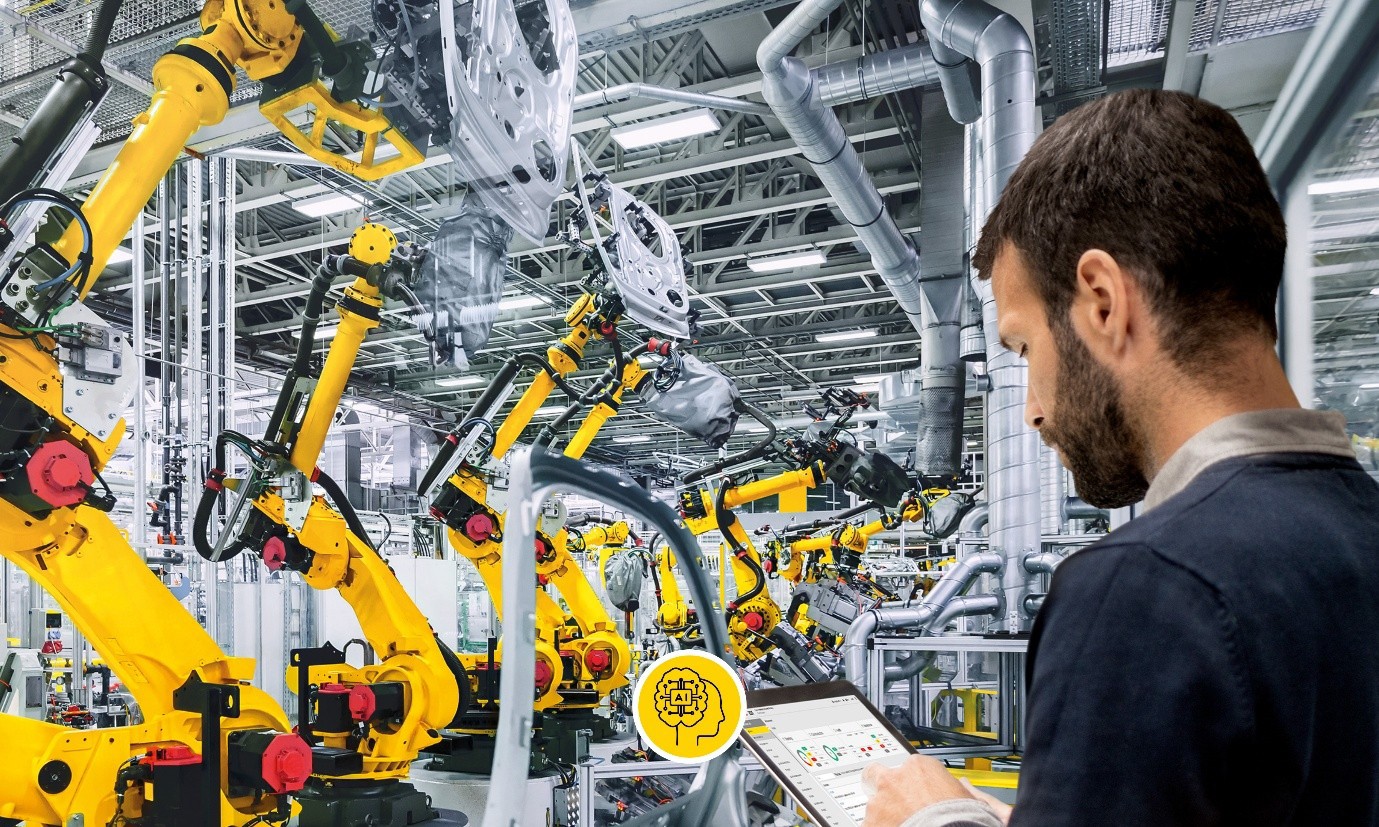
FANUC, leading global provider of factory robots and automation systems, has formally partnered with NVIDIA to bring ‘physical AI’ into mainstream manufacturing in a move set to shape the next generation of smart factories.
Under the agreement, FANUC robots will be integrated with NVIDIA’s advanced AI computing stack, including on-robot systems like NVIDIA Jetson and simulation platforms such as NVIDIA Isaac Sim. FANUC has also released support for the open-source robotics platform ROS 2 which allows programming via Python, lowering the barrier for developers, researchers and companies to build AI-driven robotics applications on top of FANUC’s robust industrial hardware.
In addition, the partnership will enable the creation of high-fidelity digital twins: virtual replicas of factories and robot fleets, where simulation can be used for training, testing and optimisation before committing to any physical robot investment. With NVIDIA’s simulation and physics-aware AI frameworks, these virtual environments can closely mirror real-world behaviour, enabling safer, more efficient and more accurate rollout of factory automation.
The benefits to manufacturers
Traditional factory automation has previously relied on robots pre-programmed for rigid, repetitive tasks; changing production lines has often meant manual reprogramming, causing unwanted downtime. The FANUC/NVIDIA collaboration promises to change that. By embedding AI, perception and real-time reasoning – components of physical AI – robots can interpret voice commands, respond to dynamic environments and work safely alongside human operators.
For the UK manufacturing sector, the implications are significant. As supply chains and production demands shift, today’s factories need flexibility. AI-enabled robots will allow existing lines to be retrofitted without major overhauls, as well as switch quickly between different product variants. Moreover, the use of open platforms such as ROS 2 and Python could stimulate a wave of innovation, enabling firms to build or customise AI-augmented robotics solutions, and leverage their own software expertise on top of FANUC’s hardware and NVIDIA’s simulation infrastructure.
A collaborative future
FANUC is set to showcase physical-AI equipped robots at key global trade shows in the near future, demonstrating real world use-cases such as voice-controlled robot operation, adaptive motion control, safety-aware human-robot collaboration, and virtual commissioning in digital twins.
For UK automation industry stakeholders – integrators, system designers, manufacturers and policy makers – the FANUC/NVIDIA partnership marks the beginning of a new era of physical AI, potentially delivering not just faster machines, but more intelligent, flexible, adaptable and human-friendly automation systems
FANUC has formally partnered with NVIDIA to bring ‘physical AI’ into mainstream manufacturing in a move set to shape the next generation of smart factories.
ABOUT FANUC
The FANUC Corporation is a global leader in industrial automation, supplying CNC control
systems, robots, cobots, and production machinery (ROBODRILL, ROBOCUT and
ROBOSHOT) to factories around the world. Since 1955, FANUC has made a significant
contribution to the efficiency and productivity of manufacturing companies worldwide.
Operating in more than 270 locations globally and serving more than 100 countries with over
9,000 employees, FANUC offers a dense network in sales, technical support, research & development, logistics and customer service.
For more information, please contact:
FANUC UK Ltd, Sapphire Way, Ansty Park, COVENTRY, CV7 9DR
Phone: +44 (0) 24 7605 3130
Email: marketing@fanuc.co.uk www.fanuc.eu/uk/en