Become a member
Take advantage of exclusive member benefits, world class events, networking and specialist support


 Become a member

 Autonomous mobile robots & Guides vehicles’
Advanced robotics
Autonomous mobile robots & Guides vehicles’
Advanced robotics
Autonomous mobile robots & Guides vehicles’
Advanced robotics
Autonomous mobile robots & Guides vehicles’
Advanced robotics
Founded in 1987, the International Federation of Robotics (IFR) is a not-for-profit organisation. It represents member companies and associations from more than 20 countries and is a global resource for statistical data and studies on robotics.

IFR White Paper (Pub: Dec 2020)
IFR White Paper (Pub: Nov 2020)
IFR White Paper (Pub: Oct 2020)
IFR White Paper (Pub: March 2018)
IFR White Paper (Pub: April 2017)
https://ifr.org/ifr-press-releases/news/global-robot-demand-in-factories-doubles-over-10-years
Frankfurt, September 25th, 2025 — The new World Robotics 2025 statistics on industrial robots showed 542,000 robots installed in 2024 - more than double the number 10 years ago. Annual installations topped 500,000 units for the fourth straight year. Asia accounted for 74% of new deployments in 2024, compared with 16% in Europe and 9% in the Americas.
IFR Quarterly Newsletter
OTTO by Rockwell Automation awarded for pioneering heavy-load AMRs and large mobile robot fleets
Seoul, Nov 19, 2025 — The 2025 “Award for Innovation and Entrepreneurship in Robotics & Automation” (IERA) goes to OTTO by Rockwell Automation for its pioneering achievement in developing the company’s autonomous mobile robots (AMRs). OTTO was the first company to build an AMR solution capable of transporting heavy loads through factories and operating in robot fleets larger than 100 units, setting a technological milestone in professional service robotics.

IERA Award 2025 from left to right: Takayuki Ito, IFR President; Ryan Gariepy, Rockwell Automation; Susanne Bieller, IFR General Secretary. (copyright: KAR).
OTTO mobile robots automate repetitive and hazardous material handling tasks in manufacturing and production environments. They transport parts, pallets, and supplies across factory floors without worker intervention. They consist of the vehicle hardware, and a software suite for autonomous operation, factory integration, fleet analysis and remote analytics. The software was developed to manage some of the largest fleets of autonomous mobile robots in the world. The navigation capabilities optimize the robot’s speed while maintaining high safety standards. This ensures efficient and predictable movement around workers on the factory floor.
“The winning robot, OTTO, marks a world-changing milestone in the development of autonomous mobile robots,” said Susanne Bieller, IERA Awards Chair and IFR General Secretary. The jury recognized the work of OTTO by Rockwell Automation, stating that they had created a mature and well-established solution for advancing the development of AMRs for material handling.
“We are deeply honored to receive the distinguished IERA award and thank the jury for recognizing our work”, said Ryan Gariepy, Vice President of Robotics at Rockwell Automation, and previous CTO/co-founder at OTTO before its acquisition by Rockwell Automation. “The prize encourages us to continue pushing the boundaries in the development of valuable, innovative technologies in robotics.”
Transportation & logistics
Transportation and logistics applications stand out in the global field of professional service robotics: In 2024, annual sales rose by 14 percent, according to the latest World Robotics report by IFR. The market share of the application class transportation and logistics hit 52% of all installations.
The finalists
The other three finalists are: Spanish automation firm Aldakin for its robotic machining head that significantly reduces hazardous dust emissions during the processing of composite materials. Fourier Rehab from Shanghai presented the “ExoMotus M4”, an advanced lower-limb rehabilitation robot designed to restore mobility in patients with neurological and musculoskeletal impairments. Youibot from Shenzhen, China, presented its humanoid “MAIC-X” a dual-arm humanoid robot for industrial inspection.

IERA Award 2025 from left to right: Wanqiu Zhao, Youibot Robotics; Jake Kee, Fourier Rehab; Takayuki Ito, IFR President; Susanne Bieller, IFR General Secretary; Ryan Gariepy, Rockwell Automation; Ibai Inziarte-Hidalgo, Aldakin (copyright: KAR).
https://www.youtube.com/watch?v=oIPvnf224xk
About IERA Award
Established in 2005, the IERA Award is presented annually by the IEEE Robotics and Automation Society Industrial Activities Board and the International Federation of Robotics (IFR). It highlights and honours the achievements of inventors with value creating ideas and entrepreneurs who propel those ideas into world-class products.
In 2026 the IERA Award session will take place at the ICRA in Vienna from 1 to 5 June 2026.
https://ifr.org/ifr-press-releases/news/pioneering-robot-otto-wins-the-2025-iera-award
Contact
International Federation of Robotics
PRESS OFFICER
Carsten Heer
phone +49 (0) 40 822 44 284
E-Mail: press@ifr.org
China´s 15th Five-Year Plan (2026-2030) marks pivot to innovation
Frankfurt, May 05, 2026 — China has launched its 15th Five-Year Plan by placing robotics at the heart of its modern industrial system. The aim is to pivot its AI research towards physical applications with robots as main drivers for economic growth. This is a next step in the country´s strong automation development: China´s manufacturing industry already has an operational stock of around 2 million units — approximately 4.5 times more than the global no. 2, Japan. 54% of annual industrial robots installed worldwide were deployed in China. This is according to the World Robotics 2025 Report, presented by the International Federation of Robotics (IFR).
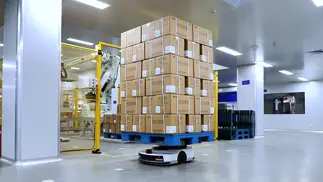
China has placed robotics at the heart of its modern industrial system © Hangzhou Robotphoenix Industrial Robotics
“The outline of the 15th Five-Year Plan of the People’s Republic of China acts as the primary framework document that sets the overarching direction for all other government actions,” says Takayuki Ito, President of the International Federation of Robotics. “Thousands of subordinate sectoral and regional plans are now mandated to align with the objectives. Under the new framework, China is shifting its focus from traditional industrial automation to high-end, intelligent robotics integrated with artificial intelligence.”
Humanoid Robot Show
China’s new blueprint sees the main value of AI in its application to business and industry. To illustrate its competences and global competitiveness in “embodied intelligence” they showcase humanoid robots that dance or run. This was recently broadcasted around the world at the televised celebration of the Lunar New Year and at the humanoid robot half-marathon in Beijing. Despite these impressive public presentations at staged events, the actual capabilities in real-world production scenarios are currently limited to demonstrators or pilot projects. Contrary to expectations, the humanoid platform itself and the embodied AI are not necessarily developed at the same time and by the same market players.
Humanoids vs. Industrial Robots
The comparison with traditional industrial robots highlights fundamental aspects of humanoid robot limitations. Critics point to the “form follows function” rule: the human body may not be suited to certain tasks. Traditional industrial robots tend to have fewer joints tailored to a specific task. This results in simpler control schemes that are faster and more reliable than humanoid robots. This is why industrial robots are likely to remain the backbone of high-speed, precision-driven manufacturing environments. In industrial production settings, tasks are repetitive and demand millimetre-level precision at high speeds. Industrial robots excel here—they perform highly specialized movements quickly and consistently. When the job calls for extreme specialization, industrial robots generally outperform their humanoid counterparts. Humanoid robots offer a more general approach. They combine mobility with human-like interaction, making them suitable for service tasks. In such applications, humanoids may be more acceptable than traditional machines.
But mass adoption as universal humanoid factory helpers or in private households will not happen within the near- and medium-term future. The 15th Five-Year plan sees the commercialization of humanoid robots rather towards the end of the plan´s period. Wide adoption of AI with traditional industrial robotics is expected over the next five to ten years.
China´s Domestic Market Potential
China’s huge domestic market offers enormous potential to implement their 15th Five-Year Plan across various branches: The share of local suppliers in domestic industrial robot installations increased from 30% in 2020 to 57% in 2024. For example, 64% of industrial robots in the global electronics industry are installed in China. Chinese manufacturers supply 59% of this industry. In the metal and machinery industry, Chinese robot suppliers even reached a domestic market share of 85%.
Contact
International Federation of Robotics
PRESS OFFICER
Carsten Heer
phone +49 (0) 40 822 44 284
E-Mail: press@ifr.org